AI PC sells for 3499 USD: how do you calculate the cost of running models at home?


A friend moved an idle mini PC into the living room last month, plugged in the Ethernet cable, installed a local model, and said he wanted to build an “AI hub” for the home. Three days later he moved the machine back to his desk—at night, the fan noise was audible through the living room door.
The idea itself is fine; the problem is that it has stayed at the “do it yourself” level. In the past two days, however, there was news that some people in Silicon Valley have turned this idea into a product: a screenless computer dedicated to running AI agents, 3499 USD, positioned like a soft router or a home NAS—on 24 hours a day, tucked in a corner and left alone.
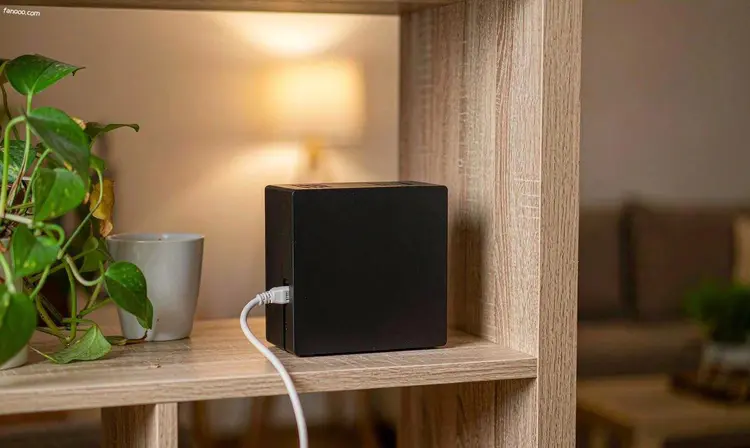
First, let’s get the facts straight.
On October 5, 2026, TechCrunch reported that a Silicon Valley company called Ghost had come out of stealth, with a USD 11 million seed round led by a16z; the founder is 19-year-old Zain Javaid. Its first product is called Core, priced at 3499 USD.
Chinese media followed up on October 23 (a DoNews report, reposted by NetEase and Sohu), adding more specific details. Core has no screen and is used day to day via a phone App or voice interaction; the system is custom Linux; it ships with three open-source models preinstalled—Qwen-3.8-Next, Qwen-3.8-27B, and Gemma-4-31B—ready to use on boot. The hardware is an NVIDIA RTX PRO 4000 Blackwell SFF GPU (24GB GDDR7 VRAM), 64GB DDR5 memory, 1TB NVMe SSD, and a Ryzen 5 7600 processor; the report mentions that the latest batch has switched to the 9600X. The official figure for the entire machine is up to 770 AI TOPS. Specifications and prices are subject to the manufacturer’s official information.
There is also a cheaper machine in the same lane. Oki Home went on sale in early October at an early-bird price of 1799 USD, including a 2TB removable storage module, and sold out in three days; the second batch is listed on the official website at 2299 USD, with shipping expected in Q1 2027. This team came out of Berkeley and was selected for YC W25. The source is an interview reposted by Tencent News on October 21 from Z Potentials.
The trade-offs between the two machines are interesting: Core puts money into compute density, while Oki puts money into “memory you can take with you.” Two answers to the same need.
What it is really selling is not a GPU.
There is an unavoidable comparison here. TechCrunch asked on the spot: a Mac mini starting at 599 USD can run agents—when OpenClaw was hot, this machine was hard to get—so why spend 3499 USD?
Zain’s answer was: the Mac mini is still fundamentally a general-purpose computer that can be “configured” to execute AI; Core was designed as a personal agent from the start, with the models and required software environment pre-integrated, so users do not have to build that whole stack themselves.
In plain words, this means:What it sells is “you don’t have to manage it.”
Tinkerers probably won’t accept this cost. Installing Ollama, setting up context, and writing a few scheduled tasks is part of the fun; if it can be done in one evening, why pay more than two thousand USD extra? But for another group of people, this is the same decision as buying a Synology instead of building a TrueNAS yourself—not because they can’t, but because they don’t want to spend their weekend on it.
So I don’t think this is a question of “expensive or not,” but of “which type of person you are.” This criterion is the same as the one I used in my“How to Choose a Home NAS”article: first look at how much you are willing to pay to save effort, then look at the specs.
Let’s do this calculation in terms of home equipment.
At current prices, 3499 USD roughly equals a four-bay NAS, plus an entry-level Mac mini, plus a hard drive budget. All three can be obtained, but you have to install and configure them yourself.
But these two sums of money do not actually overlap. A NAS gives you storage and sharing; this box gives you inference and long-term memory.If you want both, it is inherently two machines.Thinking along these lines, Core’s pricing is actually not that outrageous—it bundles the “small machine capable of running models at the 24GB VRAM level” together with the software and sells it.
The question is whether this package is worth it, and that depends on three places the official materials do not directly answer.
One: the electricity bill and noise of running 24 hours a day.
What the official announcement disclosed is compute power, not whole-system power consumption; none of the several reports I looked through contained measured noise data either. For an “always-on device,” these two items matter no less than any promotional number.
The NAS at my home had its fan replaced once before I could suppress the humming sound audible at night. The actual experience of this kind of machine is largely defined by its cooling solution: fanless is quiet but prone to heat buildup, while with a fan it stays cooler but the noise is unavoidable. Core uses a workstation-grade SFF GPU, so the cooling pressure is not small; the specific performance needs actual-device testing, and here I'm just giving a reminder,Don't just look at compute power; first think about where you'll put it.。
2. The depreciation curve may be flatter than expected.
24GB of VRAM plus 64GB of RAM counts as a mid-range configuration in 2026, and three years from now it certainly won't be considered fast. But there is a countervailing variable: models are getting smaller.
I have sorted through the model releases in the two weeks of October and wrote them inthat comparative review of open-source small models—where a 27B model has been compressed to 7.89GB, and a small host with 16GB of memory can fit it. Smaller models are good for people buying hardware: the hardware window is longer than expected; conversely, there's no need to pay extra for “the largest one it can run,” because that “largest” is being compressed on a monthly basis.
What really bottlenecks the experience is never whether it can fit, but memory bandwidth and context length. I ran into pitfalls on this point in that piece, so I won't repeat them here.
3. Whether the vendor can survive.
One point in Core's marketing that I think is very worth noting: even if the company goes under, the device can keep working—models are local, data is local, and it can run offline.
This is certainly a selling point, but it also shows that the people making the product know this is a risk. The hardware warranty is three years, and software maintenance depends on the company's lifespan; this is not new in consumer hardware, but in the context of “all your context is stored in it,” the weight is amplified.
A comparison makes it clearer: if a NAS dies, the data is still on the drives, and you can put them into another machine and keep using them. If an Agent computer dies, the things on the drive are still there, but the memory and workflows that make it “understand you” may not be so simple to restore.
The preinstalled models are open-source, but open source does not equal commercially usable.
This deserves a separate mention, because too many people stumble here. The three models preinstalled on Core all have open-source weights, butopen-source weights ≠ commercially usable。
- Recent versions of the Qwen series mostly use Apache 2.0, a permissive license, so commercial barriers are small.
- The Gemma series does not use Apache or MIT; it uses Google's own Gemma Terms of Use, which include additional usage restrictions.
- “Available for download on Hugging Face” and “usable in a product” are two different things.
If you want to use it for company work, first read the original license text in the model card; don't jump on just because of the word “open source.” This has nothing to do with how much the machine costs; it is a legal issue.
For readers in China, if you can't buy it, there's actually no need to rush.
In the reports I looked through, I didn't see a mainland-China release plan. Distribution channels, after-sales service, and Chinese-language support all count as cross-border—for the vast majority of people, any one of these three is enough to end the discussion.
But that doesn't stop us from learning something from it. What this kind of product really reveals is that “the device at home that is on 24 hours a day” is being redefined: for the past decade it was called NAS and was responsible for storage; now some want it to also be responsible for thinking.
My assessment
Three sentences.
First, this is not purchase advice; it is a signal.Next time you buy a NAS or mini PC, raise the memory spec, while the drives can be left adequate for now—Iwrote this conclusion in the local AI NAS articlebefore; now there are just two more products to corroborate it.
Second, the people who should pay attention are very specific.People who are already using always-on agents like OpenClaw and tinkering with context and scheduled tasks every day should keep an eye on this kind of product; people who just want to store photos, watch videos, and back up phones are better off with an ordinary NAS and need not spend extra on the two letters “AI.” The zero-noise all-flash machine Ihave written about beforefollows the same logic: first look at what you do, then look at what it has.
Third, the trap lies in “you think it needs no management.”What this kind of product sells is precisely “it needs no management from you,” but once problems arise—model updates, permissions, data migration, or the company going out of business—you still have to manage it, and it is harder than self-hosting because you do not know how it is organized internally. The cost of buying convenience is handing over the authority to explain it. This is the same principle as the ONT / optical modem bridge mode matter.
So what $3499 buys is not a graphics card but the phrase “it needs no management from you.” Whether you are willing to pay for this phrase has nothing to do with technology; it has to do with how much time you have. My own answer is not to buy—I have time and enjoy tinkering. But I know many people have the opposite answer; there is no right or wrong about it.
This article is based on TechCrunch’s October 5, 2026 report, DoNews’s October 23, 2026 report, and Tencent News’s October 21, 2026 repost and compilation of a Z Potentials interview; product specifications and prices are subject to the manufacturers’ official information; the judgments on electricity costs, noise, and depreciation in this article are inferences based on public information and have not been tested on actual hardware. For the open-source model licenses mentioned in the article, please refer to the original text of each model card.